
What Type of Scaffolding Is Best for Roof and Gutter Work?
Roof and gutter jobs can look simple from the ground. A few slipped tiles or a blocked gutter may not seem like a major project. Once someone has to work several metres above the ground, safe access becomes a key part of the job.
So, what type of scaffolding is best for roof and gutter work? For many domestic projects, an independent scaffold with a protected working platform is a practical choice, especially when roofers need to work along an elevation. A scaffold tower can suit shorter jobs where access is limited to one area. The right option depends on the height, roof shape, length of the work and ground conditions.
Scaffolding is not simply about getting someone higher. It should provide a stable place to work, safe access and protection at the roof edge. UK guidance says roof work must be planned properly and suitable equipment should be selected for the risks involved.
Why scaffolding matters for roof and gutter work
Roof repairs, gutter replacement and fascia work often require people to work close to an exposed edge. A ladder may provide access, but it does not offer the same working platform as properly erected scaffolding. The Health and Safety Executive advises that roof work is high risk and that safe access and protection from roof edges should be considered before work starts.
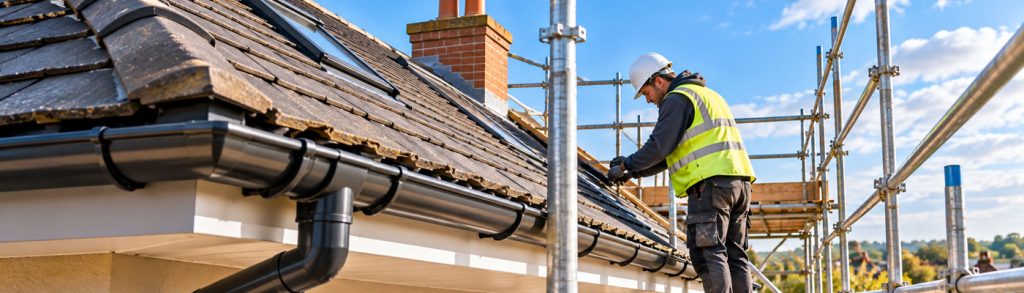
For a typical two-storey house, independent scaffolding can run along the side or front of the property. It creates a working platform at the roofline, allowing a roofer or guttering contractor to move along the elevation without repeatedly climbing up and down. Guard rails and toe boards also help prevent people, tools and materials from falling from the platform.
This is especially useful when one job leads to another. A roof repair may also involve fascias, soffits, guttering, chimney pointing or flashing. Having a suitable platform already in place can give the tradesperson access to several areas without changing the access method for each task.
Independent scaffolding can also make handling materials easier. Tiles and lengths of guttering are awkward to carry while climbing. A properly planned scaffold can provide a safer working area, although loading limits should be considered before materials are stored on the platform.
For a small repair at one section of guttering, a scaffold tower may be considered instead. Towers provide a raised working platform and can work well where the job is concentrated in one location. They still need to be suitable for the task, erected correctly and used on firm, level ground. A tower is not a substitute for roof edge protection if the work involves stepping onto a pitched roof.
Ladders can suit some low-risk, short-duration tasks, but where a safer working platform is reasonably available, a ladder may not be right for longer roof or gutter work. The access method should match the job.
Which type of scaffolding is best for a roof?
There is no single scaffold design for every roof. A small semi-detached house has different access needs from a three-storey townhouse, a home with a rear extension or a property with a conservatory close to the wall.
For many roof and gutter repairs and roofline jobs, the starting point is an independent scaffold outside the building. It can be designed around the house, with platforms at useful working heights and protection where people could fall. Where space is tight, the design may need to account for driveways, gardens and narrow access routes.
Roof shape matters too. A pitched roof needs particular attention around the eaves and roof edges. HSE guidance states that sloping roofs need measures to prevent people or materials falling from the edge. Flat roofs have different requirements, with edge protection around the perimeter.
If the work is mainly at gutter level, the scaffold can give good access to the roofline without requiring workers to walk on the roof. This is useful for gutter replacement, fascia repairs and soffit work. The platform still needs suitable guard rails, toe boards, bracing and access.
A scaffold tower can make sense when only a small section needs attention. It may suit a short repair to one elevation, provided the ground, height and working conditions allow it. HSE guidance makes clear that towers must be suitable for the work and erected and dismantled by trained and competent people.
For larger roof replacements, a wider independent scaffold may be more appropriate. It can give roofers continuous access around the building. In some projects, a temporary roof may also be needed to protect the property from rain while an existing roof is removed and renewed. JAX Scaffolding provides temporary roof scaffolding as part of its residential services in London.
The best choice comes from looking at the whole job. Height matters, but so do the roof type, access route, working time, materials and ground conditions.
What should you check before hiring roof scaffolding?
Before arranging scaffolding, be clear about what the contractor needs to do. Replacing a few tiles is different from stripping and renewing an entire roof. Cleaning one gutter is different from replacing guttering around a three-storey house.
Consider how long the work will take and whether several trades will use the scaffold. If roofers, builders and decorators all need access, a proper scaffold may make more sense than a small tower. It is also worth considering whether the scaffold needs to stay up if roofing work takes longer than planned. JAX Scaffolding says its hire periods can be adjusted to suit the project.
Access around the property should be discussed before installation. Gardens, gates, driveways, extensions and conservatories can affect where the structure can go. JAX Scaffolding describes its process as visiting the property, measuring the area, spotting access issues and deciding on a suitable scaffold design before quoting.
You should also ask whether the scaffold will extend over a pavement or road. If public space is involved, permission may be needed. JAX Scaffolding notes that it can help with council applications in London.
Do not choose access equipment based only on price. A lower quote is not useful if the setup does not give the roofer enough room to work or needs changing halfway through the project. A clear quote should explain what is being provided and how long it is expected to remain in place.
FAQ’S
Do I need scaffolding for gutter repairs?
Not every gutter repair needs full scaffolding. The right access method depends on height, the length of the repair, ground conditions and duration. A small job may suit a tower, while longer gutter replacement may benefit from an independent scaffold.
What is the best scaffolding for roof repairs?
For many domestic roof repairs, an independent scaffold provides a useful combination of access, working space and edge protection. The final design should depend on the roof, property and work involved.
Can a scaffold tower be used for roof work?
A scaffold tower can suit work at the roofline when the job is limited to one area and the tower can be safely positioned. It should not be treated as permission to walk across a pitched roof, which may need additional protection.
Is scaffolding needed to replace fascias and soffits?
It often helps where the work runs along a long section of roofline. A proper platform gives the installer room to work and can reduce repeated ladder moves. The setup depends on the property and access conditions.
How long does roof scaffolding stay up?
There is no fixed period. Some jobs take a few days, while larger roofing projects can last several weeks. The scaffold should remain as long as needed and be managed and inspected as required.